
Repair guide
Broken garage door spring: signs, dangers and what to do
If you heard a loud bang from the garage and now the door won't open (or opens a few inches and stops), a spring has most likely broken. Leave the door closed, don't keep pressing the opener, and don't try to adjust the spring yourself.
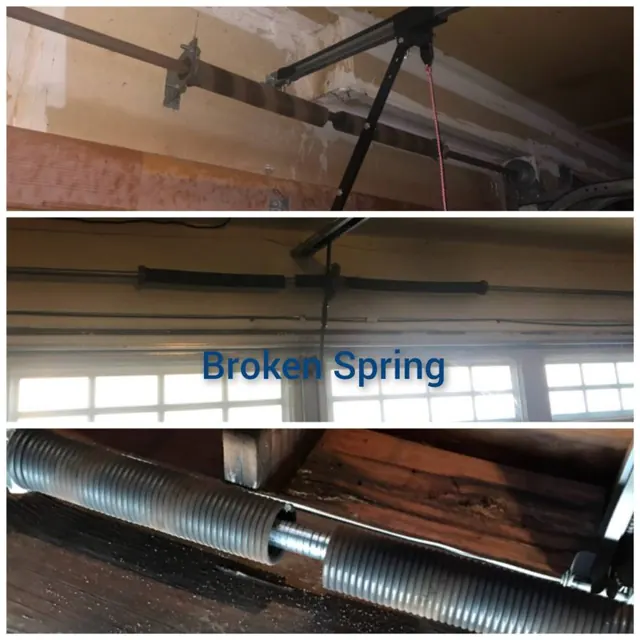
Springs do the heavy lifting on a garage door. The opener only guides the door; the springs balance its weight, which is often 100 to 200 pounds or more for a double door. When one breaks, the door suddenly feels like dead weight.
Signs your spring is broken
- A loud bang from the garage, often when nobody was using the door. Springs are under tension all the time and usually break while the door is closed.
- A gap in the coil. Look at the spring on the bar above the door (a torsion spring). A broken one shows a 2 to 3 inch gap where the coil separated.
- The door opens a few inches and stops, or the opener hums, strains, or reverses right away.
- The door is very heavy when you try to lift it by hand with the opener disconnected.
- Cables hanging loose or off their drums at the top corners of the door.
- The door goes up crooked, one side higher than the other.
- On doors with extension springs (long springs running along the tracks above the door on each side), one spring looks stretched out or is hanging down.
Why it's dangerous
A wound torsion spring stores enough energy to break bones. Winding bars slip, set screws let go, and a door that seems stuck can drop suddenly. That's why spring work is one of the few garage door jobs we tell every homeowner not to try.
What causes springs to break
- Normal wear. Springs are rated for a number of open-and-close cycles. Standard springs are commonly rated around 10,000 cycles, which is roughly 7 to 10 years for a household that uses the door a few times a day.
- Rust. Rust adds friction between the coils and weakens the steel. Homes close to the bay see more of it.
- An unbalanced door. If the door was out of balance, the remaining spring and the opener worked harder.
- Cold mornings. Steel is less forgiving when it's cold, so breaks often show up on the first chilly days of the year.
One spring or both?
Many doors have two torsion springs. If one breaks, the other has the same number of cycles on it and is usually close behind. Replacing both at once keeps the door balanced and saves a second visit. On heavier doors, or if you use the door a lot, ask about high-cycle springs that are rated for more cycles.
What the repair involves
- We confirm which spring broke and check the cables, drums, bearings and rollers, which often take a beating when a spring lets go.
- We match springs to your door's weight and height. The right spring is about wire size, inside diameter and length, not just "a spring that fits".
- The new springs are wound and the door is balanced, so it stays put when you let go of it halfway up.
- We test the opener's force and auto-reverse settings so it closes safely.
If your door still uses extension springs, it's a good time to ask about a torsion conversion.
Questions
Can I open my garage door with a broken spring?
It's not safe to try. With the spring broken, the door's full weight is on you or the opener. If you must get a car out, call first; the door can sometimes be opened safely with two people and a clamp, but it can also fall.
Can I replace a garage door spring myself?
We don't recommend it. Torsion springs are under high tension and need proper winding bars and the correct spring size. Extension springs need safety cables so a broken spring can't fly loose.
How long do garage door springs last?
Standard springs are commonly rated around 10,000 cycles, or roughly 7 to 10 years of normal use. Higher-cycle springs last longer.
Should both springs be replaced at the same time?
Usually yes. Two springs installed together wear out together, so replacing both keeps the door balanced and avoids a second break soon after.
Is a broken spring an emergency?
If the door is closed and you don't need the car, it can wait for a scheduled visit. If the door is stuck open or a car is trapped inside, call us. We're open 24/7.